


On the three ordering decisions every practice makes every week — and the information gap behind all of them
Somewhere during the week, someone stands in the dispensary and looks at the shelves. Is there still enough? Should we order now? How much? And from which supplier, given availability, minimum order quantity and free-shipping threshold?
It looks like a practical question. In reality, it is an economic decision. And in many veterinary practices, that decision is made several times a week on incomplete information.
This article is about three stock problems every practice knows: too little stock, too much stock, and the timing of the order itself. They seem unrelated. But the cause is often the same.
There is no complete, up-to-date picture of what is on the shelf, what moves through it, what it costs, and what is available from which supplier.
Situation one: too little stock
The most visible problem is also the most concrete: you need something and it is not there.
But what really goes wrong happens earlier. Not at the moment the product runs out. By then there is little left to do. It goes wrong at the moment no one saw it coming.
Conversations with veterinary clinics in Germany keep surfacing the same picture. Stock is often checked visually. Someone walks past the shelves, looks, counts or estimates. Sometimes there is a list, cards or a system. But as soon as products are not logged consistently, the picture no longer holds.
One practice described it like this: as long as products are entered into the system correctly, the ordering process works reasonably well. But as soon as that does not happen, products are sometimes suddenly gone without anyone expecting it.
When a product is missing, the search begins. Is it still available from another supplier? Is there an alternative with the same active ingredient? Is there a generic that would also work?
That answer often sits in the head of whoever usually orders.
“I know the alternatives by heart. But if I were to hand it over to a colleague, the platform would have to show that.”
— Practice owner, small veterinary practice, Germany
If that person is not there, the search starts over. The fallback is rarely a system. More often it is ordering ahead for holiday periods, so that as little as possible has to happen while someone is away.
In VetProcure research among 172 European veterinary practices, almost two-thirds of the clinics in Germany report that product availability is the biggest bottleneck in their ordering process. (Source: VetProcure Vet Clinic Insights Survey, n=172, 2024)
This is not only about availability in the market. It is also about information at the moment of ordering: you do not always know what is available, from whom, at what price, and when you should have ordered to avoid a shortage.
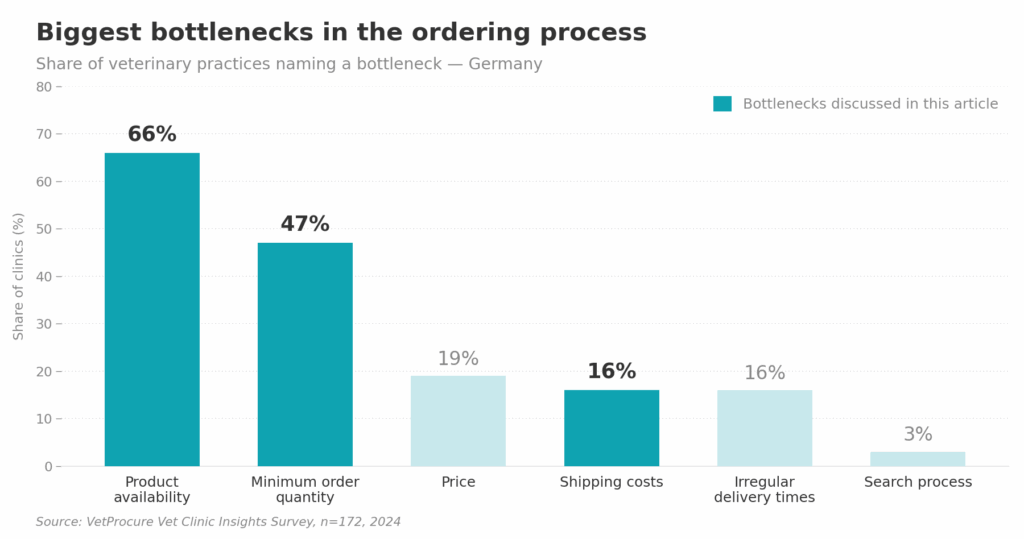
Availability and minimum order quantities are the two most frequently cited bottlenecks — exactly the situations this article describes.
Situation two: too much stock
The opposite situation is less visible, but financially just as relevant.
Whoever never wants to run short orders generously. Whoever can capture a volume discount orders more than strictly needed. Whoever wants to clear the free-shipping threshold adds something to the order. All understandable decisions. Together they can lead to stock that sits quieter than it should.
Stock is not revenue. It is capital sitting in the cupboard, waiting.
Every box that sits on a shelf for months is money that is not available for staff, equipment or practice profit. For a veterinary practice with healthy revenue, that can quickly run into tens of thousands of euros.
According to VetProcure’s own research, in the veterinary sector an average of twenty to thirty percent of gross revenue goes to procurement and inventory management. A share that has risen further in many practices over the past decade. (Source: VetProcure Vet Clinic Insights, 2024)
A healthy inventory turnover for veterinary practices sits at eight to twelve times a year. That means products spend, on average, no longer than thirty to forty-five days on the shelf. Most practices do not know that number, because it requires a clear view of both your unit cost and your average inventory value. That information is usually scattered across supplier websites, invoices and someone’s memory. (Source: University of Adelaide, Veterinary Introduction to Business and Enterprise — Key Performance Indicators, based on Stowe 2004; confirmed by ezyVet Veterinary Inventory Management Guidelines, 2025)
On top of that comes a cost that is rarely named explicitly: expired products.
Whoever orders generously for a volume advantage takes the risk that part of the order reaches its expiry date before it is used. Research published in BMC Veterinary Research on expired medicines in veterinary supply settings names poor demand forecasting as a structural cause, alongside overstocking and ordering without a clear view of existing stock. (Source: BMC Veterinary Research / PubMed Central, 2023)
Ordering generously is therefore not wrong by definition. For fast movers it can be rational. But for less predictable products the same logic is sometimes applied without a sharp view of actual usage.
Good inventory management starts there: knowing what actually moves through.
Situation three: the timing of the order itself
The most underestimated situation is neither the shortage nor the overstock. It is the weekly trade-off that comes before both: when do I order, how much, and from whom?
That choice looks simple, but in practice several variables are in play at once.
First, the free-shipping threshold. Ordering below the threshold means paying shipping costs, and that feels like a waste. So you wait. Or you add something you do not actually need yet. Understandable. But meanwhile, stock grows with the threshold, not with actual usage.
Then the minimum order quantity. With suppliers you order from rarely, that becomes a structural dilemma. You need one product, but the minimum order quantity forces you to take three. The two extra sit in the cupboard. Until they are needed, or until their expiry date approaches.
Almost half of the 172 surveyed veterinary practices in Germany name minimum order quantities as one of the biggest bottlenecks in the ordering process. (Source: VetProcure Vet Clinic Insights Survey, n=172, 2024)
And then there is the factor that makes the timing of the order even more fragile: availability at the supplier.
A product can be available today and temporarily unavailable next week. Sometimes it is resolved quickly. Sometimes it takes weeks. And often the practice only finds out at the moment it wants to order.
That makes waiting risky. But ordering too early is not always wise either.
Wait until you clear the free-shipping threshold, and the product may no longer be available by then. Order earlier, and you may pay shipping costs or tie up stock unnecessarily. Switch to another supplier, and the price, the delivery time or the minimum order quantity may change.
This is exactly why the timing of the order is not a simple operational task. It is a trade-off between cost, risk and availability.
And that trade-off is often made without all the information side by side.
What the three situations have in common
Too little stock, too much stock and the postponed order seem like three separate problems. In reality, they are often three responses to the same uncertainty.
- Whoever is unsure when something will run out tends to order too much.
- Whoever does not know what is available from other suppliers waits longer or searches ad hoc.
- Whoever cannot see what a product really costs across different suppliers keeps ordering where they always ordered.
- And whoever does not know whether a product is about to go out of stock has to gamble: order now, wait, or switch.
This is not a lack of care. It is how the ordering process has grown in many veterinary practices: per supplier, per person, per product. With information scattered across websites, invoices, inboxes, lists and someone’s memory.
The full picture has never been there.
Not a decision, but an estimate
Every ordering round starts again from what is visible. What is still on the shelf? What is on the list? What does the person ordering still know by heart? Which supplier do we usually use?
But the information needed for a good decision is broader than that.
Current stock. Current usage. Current prices. Minimum order quantities. Free-shipping thresholds. Availability across all suppliers. Alternatives when a product is unavailable.
That information does exist. It is just rarely in one place. And almost never exactly at the moment the decision is made.
The result is that many ordering decisions in a veterinary practice are not real decisions. They are estimates.
What would you gain if that picture were there?
If, at the moment of ordering, you can see what is available from your suppliers, what it costs including your own terms, and what you have ordered before, the quality of the decision changes.
The chance of shortages drops. Not because you order more, but because you see earlier where risk arises.
Overstock drops. Not because you dare to order less, but because you can buy closer to actual usage.
The timing of the order gets sharper. You see sooner whether waiting is wise or risky. You see whether you will clear the free-shipping threshold. You see whether an alternative is available. You have to do less arithmetic in your head.
Insight is not the goal in the end. Better decisions are the goal.
Which of these three situations costs your practice the most money: shortages, overstock, or postponed orders?
VetProcure helps veterinary practices connect their existing supplier accounts, see prices and availability side by side, and make better ordering choices faster.
Free for veterinary clinics. No IT setup required.
Register for free or book a short demo if you want to see how it works first.